
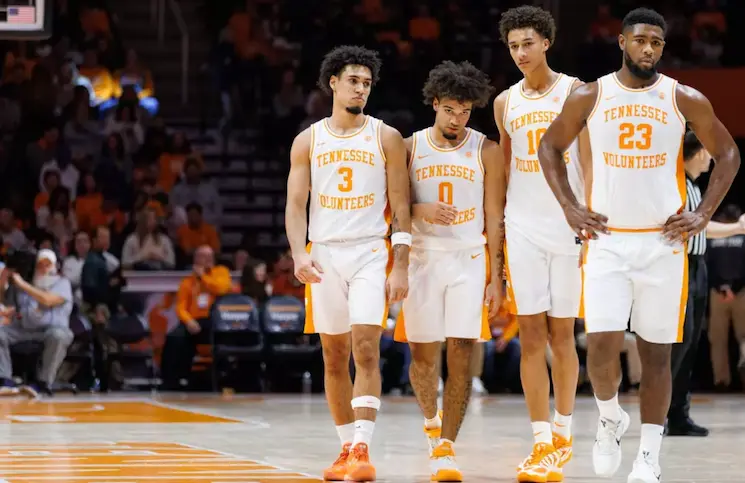
The show gets real for Tennessee basketball Saturday afternoon when they open up SEC play with a top 20 matchup at Arkansas. Tennessee went 10-3 during non conference play including a 3-3 record against power five opponents.
Here’s five numbers to know as Tennessee basketball pivots from non-conference to SEC play.
More From RTI: Rick Barnes Anticipating ‘Incredible Strides’ From Nate Ament In SEC Play
18.5
The percentage difference in Tennessee’s offensive rebounding and defensive rebounding rate. Tennessee is rebounding 46.1% of its missed shots while opponents are rebounding just 27.6% of their missed shots against Tennessee. The Vols rank first nationally in offensive rebounding and 68th nationally in defensive rebounding.
Florida is currently the only team in the country with a wider margin which, by the numbers, makes Tennessee the second best rebounding team in the country.
As a point of reference, Tennessee finished with a +5.3% rebounding difference a season ago. The Rick Barnes era best is 9.5% in 2022-23. The program-best in the KenPom era is 12.2% in 2013-14.
That margin is bound to drop over the course of SEC play but Tennessee has still been a great rebounding team in its six power five games to date.
60
What Tennessee is shooting from the free throw line in its three losses this season. The Vols missed just five free throws against Kansas but shot a putrid eight-of-15 from the line against Syracuse and an even worse eight-of-18 against Illinois.
The Vols are making 72.2% of their free throws in their 10 wins including a clutch eight-for-eight stretch to ice the Houston game. On the season, Tennessee is shooting 69.9% at the line— a near 2% worse than the national average.
This is going to be a re-occurring theme this season as Tennessee plays more inside out. Jaylen Carey is going to be a key. He’s shooting 48% with the third most attempts on the team. The good news is Ja’Kobi Gillespie and Nate Ament are both good to great free throw shooters and should be shooting them in crunch time.
12
The difference in Ja’Kobi Gillespie and Nate Ament’s field goal shooting in Tennessee’s three power five wins and three losses. The duo shot a combined 42% in wins over Rutgers, Houston and Louisville. They shot 30% in Tennessee’s three losses.
Gillespie and Ament are the offensive leaders on this team. When they have struggled, Tennessee has often struggled badly.
It’s worth noting that they took nine more shots in the losses then they did the wins. Part of the efficiency issue is that Tennessee’s role players have not performed particularly well in the losses. That’s putting more on both players’, especially Gillespie’s, plate.
27.2
The percentage of Tennessee’s scoring that’s come from the three-point line this season. It’s the lowest percentage since the 2019-20 season when Tennessee scored 27% of its points from beyond the arc. It is not a shocking development given the Vols’ roster build but it does emphasize that this is an inside-out team.
Tennessee is currently shooting 57% from two-point range which ranks 61st nationally and is currently the best mark of Barnes’ tenure. Like rebounding, the numbers will almost certainly dip in SEC play. Tennessee is shooting 50% from two-point range in its six games against power five opponents.
Even then, Tennessee has shot over 50% from two-point range four times in Barnes’ 10 seasons as head coach.
13 and 14
Tennessee’s rank nationally in three-point and free throw defense, respectively. The Vols could be in for some regression here in SEC play.
Three-point defense is always a tough one to quantify. There’s an element of luck to it, but Tennessee has also been elite there each of the last five years, ranking in the top 75 nationally each year and the top 10 three times. If there is some regression, recent history tells us it won’t be significant.
There’s no defense on free throws. Tennessee has been fortunate that its opponents have shot so poorly from the line this season. That will likely even out over the court of the season.