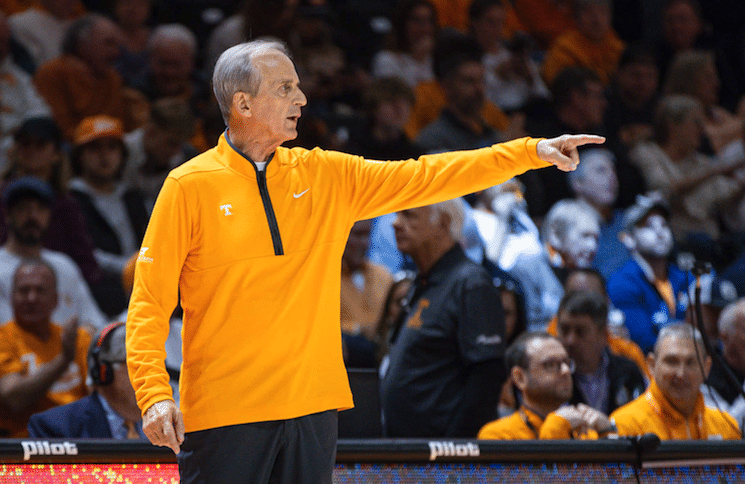


New Tennessee basketball assistant coach Earl Grant met with the Knoxville media on Thursday afternoon for his introductory press conference after joining Rick Barnes’ staff in Knoxville.
Grant discussed what attracted him to Tennessee, his initial impressions of the Vols’ roster and much more. Here’s everything Grant said.
More From RTI: What Rick Barnes Said About Tennessee Signing Notre Dame Forward Jalen Haralson
On the phone call he had with Rick Barnes that led to him joining the Tennessee coaching staff
“I mean, obviously, spent five years at Boston College as the head coach and then seven at College of Charleston. Really wasn’t looking for a job at all. Didn’t need a job. Prayed a lot about it. Was looking for an assignment. And I felt like when Coach Barnes called me, and he painted a vision of what he would want me to do, what role he would want me to play to help the program to continue to move forward, it just felt like a perfect assignment for me.”
On what those things were that Barnes wanted from him in this role
“Just continue to help the team be an elite defensive team, continue to recruit. But for me, I was looking for a situation where I could continue to build good relationships with staff and players, make an impact through relationships and just serve. Serve the coaches, serve the players and that’s kind of what I was looking for. And when he spoke to me about the opportunity, it was too good to turn down.”
On when he first met Rick Barnes and how that relationship has grown over the years
“Yeah, I was a fan of Coach Barnes growing up in South Carolina. He was the head coach at Clemson and he recruited a guy that was one of my high school rivals, Harold Jamison. And I followed Clemson basketball. He was the coach. And then just over the years, we would see each other out recruiting. We built a relationship that way. But he and his wife would travel to South Carolina on vacation when I was the head coach at College of Charleston. And I kind of had a little GPS radar on him. I knew he was coming, so I would ask him, ‘Hey, can you come over? I want to talk basketball. I want to learn, try to build this program at College of Charleston.’ And we would start out saying we got one hour, and it would last for three hours just talking about basketball and how you build a program. And so really, our relationship strengthened when I was the head coach at the College of Charleston.”
On what he knew about Tennessee basketball before this job was on his radar
“What I know is there’s been a lot of people that came through here and won big. Recruiting high character, tough players over the last 30 years. Men’s basketball and women’s basketball, they got a winning tradition. And so it was something that I knew that 20 years ago. I saw Chris Lofton the other day, and when I was at Winthrop, and we played Tennessee in (the NCAA Tournament in) Greensboro, North Carolina. And we were up two with fricking four seconds left. They called a time out, drew up a play.
He set a back screen for one of those bigs that they had, Major Wingate or somebody. I don’t know who it was. And then he comes flying off of a screen and hit a three, falling out of bounds with one second on the clock to advance in the NCAA Tournament. So I saw him the other day, and I said, ‘Man, I don’t like seeing you, but I’m a part of your program now. No more nightmares. I’m with you.’ But yeah, that’s one of my experiences with Tennessee. They’ve had great teams. CJ Watson was on that team as well. A lot of great players.”
On how valuable his conversations with Barnes were during his career as a head coach
“Yeah, it was valuable. I remember something he said. As a young head coach, you’re trying to do so many things and you can’t be good at everything. So he looked me right in my eyes. He said, ‘Hey, look, everything we’re talking about sounds great, but you have to remember, you only can be good at three things. So you got to figure out what you want to be good at and spend all your time there.’ So that’s something that stuck out to me. I think that was my third year as the head coach, and I really simplified and tried to get good at three things and spend all of our time on those things. So I do remember him making that statement.”
On what those three things were for him
“Defend, rebound and take care of the ball.”
On his first impression of Rick Barnes as a person, not just a coach
“A family man. Somebody whose faith was important to him. And just a competitor. Somebody who just wants to win and compete at a high level. And so those are the things that jumps out to me the most, just from spending time with him.”
On leaning on his faith between jobs, having that common bond with Barnes
“Well I had four weeks in between jobs. So a lot of hot yoga. A lot of reading. And I’m like, ‘Man, how much more can I read?’ Reading, jogging, hot yoga, kind of found a rhythm. I enjoyed it. So a lot of thinking and a lot of praying. And the thing that just kept coming to me is you got to find somebody you can serve. Because I thought about doing NBA scouting, talking to different people in the NBA, but there’s no relationships in scouting. So you got to find somebody you can serve. That’s players and assistants and the head coach. Relationships, relationships, relationships. That drives me. And then make an impact through serving the relationship. That’s it. So I think having that time, doing the hot yoga and praying and walking and reading, it came clear to me, don’t worry about trying to get a head coaching job. Just go find a place that’s a great assignment, so you can serve and have great relationships.”
On the point when he knew he was taking the Tennessee job, when he started spending time in Knoxville
“Probably spring football, that Saturday (of the Orange & White Game), whatever day that was. It’s a blur. About 10 days ago. Me and my wife came up, and we actually had went to another campus, another university. I won’t name their names. Really good institution. And, man, all this stuff happened, like, in three days. Tennessee and this other institution. But when I came here and Coach Barnes picked us up from the airport and from just kind of spending time on campus and meeting so many great people, it was very evident that this is a special place.”
On what stands out about what Tennessee has done in the transfer portal
“It’s been very impressive, the type of talent we’ve been able to attract. The guard play, the forwards. It’s been very impressive. I think we’ve got a team that’s interesting. Obviously, we haven’t coached these guys, but we got a lot of talent. So I’m excited about that.
“But what’s impressive is just Coach Barnes’ ability to communicate with these players, cast a vision of why they should come to Tennessee. Obviously, he’s got a lot to offer because of the three Elite Eights back to back, the number of professional players he’s coached. Obviously, his faith, how you gonna love them and challenge them. So it’s been impressive. When you’re a head coach, you’re the lead on those Zooms. So we’ve got about 17 Zooms, and I’m sitting there, I’m a fly on the wall now. I’m not leading every Zoom. So just seeing him lead them and have so much energy and so much— casting such a great vision, it’s been pretty impressive.”
On what stood out about coaching against Dai Dai Ames
“Toughness and speed and really a great ability to get to the paint and score, but very unselfish. Always looking for his teammates. That jumps out to him.”
On the challenge of helping install Coach Barnes culture as a new coach with a new roster
“I mean, just learn as much as you can day-to-day because the only thing that matters is what Coach Barnes want. So we got to push his vision forward. That’s the only thing that matters. So still learning a lot, but it still goes back to serving and relationships. Trying to get to know the players, trying to get to know the staff. Just helping them, serve them and be somebody that’s a good teammate. And so that’s kind of what I’m looking forward to the most.”
On talking about serving, how attractive the Tennessee program was from that perspective
“They got real great humility in their program. I know they got a slogan, ‘It’s not about me.’ So anytime a man can look himself in the mirror and say that, it’s nice to learn that before you become a husband and a father. But that’s really– that’s the model for Tennessee. When you got a wife and three kids, you learn pretty quickly it ain’t about you. So I think it’s really good that they’re driving that message early. Just excited about the culture, being a part of the culture that they built.”
On his desire to help push Tennessee to its first ever Final Four
“Yeah, I mean, I’ve always had a dream to coach a team to the Final Four. That’s a dream of mine, and that is still a dream of mine as a head coach. But this is an opportunity to help somebody else. And so for me, I just want to see Coach Barnes be successful at the highest level he can be. He deserves it. He’s a legend in this game, and so you want to help him. You just want to help him be the best we can be, whatever that looks like as we go through the summer, coming into the fall. Just give good effort every day to help him, and whatever that means, we’ll see what it look like at the end. But that’s what I want to do.”
On his impression of returning players DeWayne Brown and Troy Henderson
“Well, No. 1, I’m glad that they’re here. Both of them are good players and good talented guys with high character. And they had good success as freshmen. It’s hard to play at this level as freshmen. I know DeWayne played a lot as a freshman, and Troy played some. He had some good flashes, some good games. So I’m happy they’re here because somebody got to carry the culture, and it’s nice to be able to go in the locker room after a hard workout and say to the other guys, hey, you can say something about the culture. You can say something about Coach Barnes based on your experience. And so if you didn’t have those two, then everybody’s new. But I think having those two, they can kind of help carry the culture and just talk about what it’s like to be a Volunteer.”
On where his serving motif came from in his coaching philosophy
“I don’t know. I mean, I played junior college in Division II, so I watched the coaches at that level not have many resources, not have many assistants. So they did everything. They drove the van, they taped ankles, they prepared the sandwiches. And so I think just coming up, watching my dad at a young age have to learn how to walk and talk again after having a bad accident. So just couldn’t walk and talk for like three or four years, but he learned to do it and started a company, a landscaping company.
“So I think just seeing my dad, my parents, my coaches— just I’ve seen them serve. I think that’s probably the most important thing you can do as a man is serve somebody else.”