
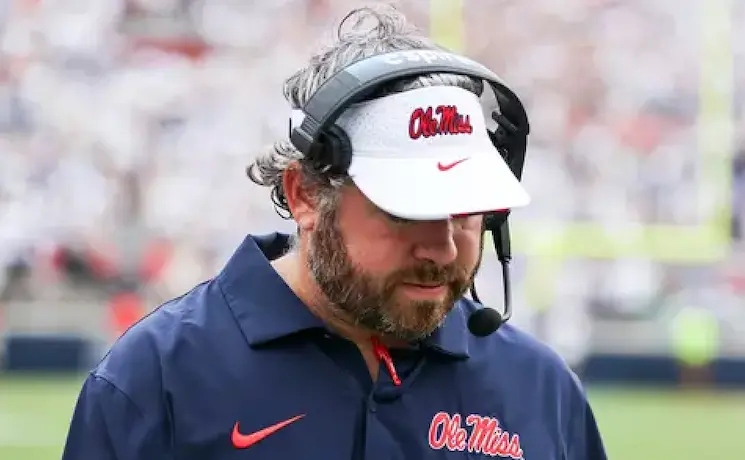
Ahead of the College Football Playoffs, Ole Miss football head coach Lane Kiffin departed from the program for LSU. In response, the Rebels elevated Pete Golding to head coach and keep him in the position for the upcoming 2026 season.
Now, Golding is at his first SEC Media Days. Taking the podium, he was asked about his relationship with Kiffin, accusations of tampering and more. Here’s what he said.
More From RTI: What Florida Football Head Coach Jon Sumrall Said at 2026 SEC Media Days
PETE GOLDING: Wow, what a fancy welcome there. Appreciate it, Greg.
To start, obviously Greg and his team and his office, has been really unique this spring. Have been in the SEC for nine seasons now, but this spring getting to sit in on those head coaching meetings and learn from Greg and his staff and all that they put into not only for our coaching staff, but for our players in this league.
So just really admire Greg and his staff and Greg for his leadership and what he does for this conference and for college football. Definitely wanted to tell him thank you.
And then having been in a lot of different places and having been at a place that had a lot of success in this league, I think when you start looking at programs I think vertical alignment is so important.
What I mean by that, our chancellor, Glenn Boyce, at Ole Miss who’s an Ole Miss grad, a former high school football coach, but his investment into athletics and into our athletic director, Keith Carter, is something that’s been remarkable and put us where we are right now.
Really, really thankful for Glenn Boyce, our chancellor, and Keith Carter, athletic director, who also played at Ole Miss. It’s really cool for both your bosses to have been there and played there. It really helps from a recruiting standpoint, because that investment is just completely different.
So we definitely would not be where we are as a university right now and as an athletic program at Ole Miss without Glenn and Keith working side by side.
They embody everything Ole Miss is about. Our program sees their leadership come through it, and also our university. So really appreciative of those two.
That takes me to Oxford, to Ole Miss. It was a unique decision for us to leave Tuscaloosa to go to Oxford. It was strictly a family decision. It feels like it was yesterday when that occurred over three and a half years ago. The people there have embraced us. We have family there. We have a lot of cousins there and all that, but the people and the quality of people in that place and the community and how they embrace the school and our students, the way they impact the environment not only at home games but on a day to day is something really, really remarkable that makes Ole Miss such a special place.
So really appreciative to our students and the community and the involvement of not only my family, but our program and our players. I think if you come to Oxford and you come to game, I think that’s something that you definitely, definitely feel.
I think obviously coming off the success of last year, when you’re going into an offseason you look at those lessons that you learned throughout the season and towards the end of the season when it didn’t go exactly how you saw it going. You try to figure out, all right, how can we do it better?
That’s what we been doing to me since January 9th. It’s how you evaluate the program. How do we do it better and work harder to take every step in every area of our program to improve. I think that’s year in and year out.
I think within that, when you look at improvement and you look at consistency and performance at other places, places that I’ve been, stability and schemes are so important to that.
I was really, really, really glad that I was able to retain a lot of really good staff on both sides of the ball. Really on all three phases. When you look at offense and keeping Joe Judge who has done an unbelievable job; bringing John David Baker back, who was the co-offensive coordinator in 2023 that had been in the system. Went off, got his teeth cut right, called really good offenses at East Carolina. Did a really good job to get him back.
To be able to keep John Garrison as our offensive line coach in a system that this will be the seventh year of that system at Ole Miss. To be able to keep B Brown and that defensive staff and Randall Joyner and all those guys that have been with me for so long, to be able to keep that stability within that room, to be able to keep Coach Schoonover in our special teams.
So we were able to keep stability in all three phases, which I think is so, so important for development of your players. For freshman to become sophomores and sophomores to become juniors to learn more about those languages and those systems.
I was really fortunate to be able to keep and retain a lot of those guys. I think we’ve been really fortunate to add a lot of really, really good human beings on both sides of ball. Just so happened to be a very unique year to where a lot of these guys were former Ole Miss alum. The Terrence Metcalfs of the world, the Michael Spurlocks of the world, the Moncreifs of the world and the Marcus Woodsons of the world, and they’ve created so much value for our players, not only from a relationship standpoint, but the investment into them and making them better human beings has been really awesome to see in the spring.
So really appreciative of our staff and of our players, how they worked since January the 9th. We still know there is a lot of work to be done. We know every season is independent of their own. The legacy of last year’s team is over. We can learn from that obviously moving forward, which we have all spring. How do we do certain things better and do it on a more consistent basis.
But this is a new group. We added 50 new players in the spring, 29 via transfer portal and 22 from a high school standpoint, and added a couple more of those in May to get us to 51. So seeing that gel and come together has been really cool.
Part of that reason I think is three of the guys that we brought here today obviously in Trinidad and Kewan and Will. You know they’re really good players. I’m not going to talk to you about that. Ya’ll already know that.
Rule No. 1 in our program is be a good dude, and that ain’t too hard. I got two boys like Greg talked about, and I hope one day my two boys are like one of these three. They’re tough, competitive, they love football. That’s who we look for from a recruiting standpoint, but more importantly they’re good people. They affect the people around them in a, really, really positive manner.
And so it’s been really cool to see a lot of really good players, new players come in, but they’re adapting to the guys that have been there, right, and understand the culture and the expectation. For them to bring them with them has been really cool to see.
So super excited ya’ll get to hang out with Kewan and Trinidad and Will. You’ll see it when you’re talking to them. They’re awesome dudes, really good football players, but are a big part of the culture and where we are at. We got a lot of guys in our locker room like that, and it’s really cool and a really unique team.
But we know every season brings challenges. Obviously we’re excited for the challenge. We know there is still a lot of work to do. Obviously getting into camp here starting in August 6th, we’ve got to stay healthy and making sure we’re getting guys in the right spot.
It’s really important for us. From a personnel standpoint, I think we’ve created a lot of depth across the board on both sides of the ball to make sure we’re using those pieces effectively and hold them accountable.
But really like where we are and really appreciative of our staff and players and their hard work and excited, and playing really, really good Louisville team to start the season at neutral site.
With that, I’ll open it up for questions.
Q. Just now that you’re mostly through your first offseason as a head coach, what’s been the biggest difference between this offseason and the other ones at Ole Miss? What have you learned from the offseason as a head coach?
PETE GOLDING: The first thing obviously and kind of the turmoil of everything going on and the retention of people and getting the thing fixed, we had ti hire a strength and conditioning coach. That’s always the first thing. You get back January 9th from the game. They get a little bit of a break and then you start your offseason program.
So bringing in Paul Constantine No. 1, who was our No. 2 when I was at the Alabama. He was the No. 2 with the Falcons, so he came to us from the Atlanta and kind of switching that model in the weight room to a velocity-based training model, which is speed of the bar and getting his staff, because I feel like the game is now kind of a blend between college and NFL.
I don’t think it’s old school college and it’s not all the way to the NFL. So I thought it was really important to get an NFL mind that’s been in this conference and had success and also been in the NFL and be really smart on how to set up the offseason, not only in the weight room from a strength and conditioning standpoint, but from a football intelligence and football school and the spring model and all that.
To me it’s not exactly the same like it used to be based on how long the season is, so we kind of broke it up into three phases in the offseason. Very much NFL, phase 1, phase 2, phase 3, and then we broke up the summer into block 1 and block 2.
So different model for the players. To me, when you’re recruiting all these guys want to get developed at their craft, so we look at it every day that there is an opportunity for guys to come into our building and develop and improve at their craft.
In order to do that you have to have something every day. When our players are on campus our coaches are on campus, and that’s a model I changed from previous places I had been.
I like the progression and I like where we are at. They’re about to come up on a discretionary week next week. We are going to give them a week off and then have a little OTA prior to fall camp.
A little different structure than they’re used to, but I am just really, really big on the why. As long as you can tell them why and this is the reason why and I hear the results, I think they’ve seen the results throughout the spring in they’re bodies and speed and jumps from a weight room standpoint, and I think it’s allowed us as coaches to slow down the install to really teach these 50 new guys that we got coming in that now it’s not, hey, I hope they get it. You’re investing a lot into these guys in order to play in the fall. We got to make sure that we’re teaching it the right way and the right progression.
That definitely changed it up, but obviously the principles are still the same. The foundation of strength and conditioning and football intelligence and then getting into our player-run model.
Q. You spoke about how you’ve made some changes within the program. Going from defensive director to head coach how have you changed?
PETE GOLDING: I’m a little skinnier. No, you know, obviously when you’re responsible for a side of ball you run it like it’s your team. So no different than a defensive unit meeting. There are things that you believe in that you want to make sure you get across, but you also have really good other defensive coaches that you have to allow to coach.
And so when I made the transition and I knew I was still going to call the defense by talking to other people and that’s really the only reason that was keeping me from taking a head job, was I loved being a coordinator, was I was going to have to hire guys to do all the head coach bullshit that I don’t enjoy doing to where I can still focus on coaching football and being around our guys.
So part of the staff build, the Tom Lukes of the world, the Todd Cooleys of the world, right, the Austin Thomases of the world, those guys around me, they handle all that crap and keep it off my desk so that we can focus on still recruiting really good players and coaching good football.
So that piece to me was really, really important. So now your staff meeting is a little bigger than your unit meeting was. Team meeting is a little bigger than your defensive unit meeting was, but the principles are the same. I think it’s unique for me that I had already been there three and a half years. They know why I came and I was staying regardless of the role. So that buy-in has been a little different.
The delegation piece has been a process for me throughout it. Really, all right, what are you going to take your hands off and let them go do their job get the hell out of their way and not micromanage everything and everything has to be perfect and all those things.
Probably the delegations component and then really deciding we’re going to keep our focus here and let Coach Cooley and let Tom Luke and let all these guys who are really good at their job handle that for you, which has been really, really awesome.
Q. The school rolled out the Heisman campaign for Trinidad and Kewan yesterday. What went into A, combining the two and the process of putting it out so early?
PETE GOLDING: No. 1, I think individual accolades in my opinion come from team success, and so that was a body of work I think from last season for both those guys to have really, really unique individual years because of a lot of really, really good players around them.
I think they would be the first ones to tell you that.
But I do think a lot of these guys are putting a lot in and they’re working extremely hard and we demand a lot out of them. But there are some of these individual awards for them that are important to them, and it’s not going to take away from what they need to do to win the football game.
I think 5 will be the first one to tell you that. If we need to throw it 60 times to win, let’s throw it 60 times to win. Your concern always outside looking in is, hey, does this become a distraction? Those two are wired the right way. I’m not concerned with how they’re going to practice and prepare. They’re going to do everything they can to win the football game, and they know that’s based on their preparation.
And so I have zero concern of it affecting them and becoming an issue, so I’m all about putting people in position to have success, whatever that is. I feel like that’s why they call us coaches. It’s no different for a player for the next 40 years of their life. It’s our responsibility to educate and equip them to have success.
To me it’s just an avenue. You got two really elite players coming off really, really good years that still have a lot of really good players around them in the same system that are set up to have another really, really good year, and so I think it’s part of our responsibility to put them in position to have as much success as they can, that being part of it.
Q. As a defensive coach, which offensive concept is the hardest to stop today?
PETE GOLDING: The one that works. No, it depends who you have. Obviously week to week, that’s what I love about this league. That’s what I loved about growing up Division II and 1AA. You see so many different schemes week in and week out. From a defensive standpoint there is one thing, what are they doing and what do we need to do to take that away. All right, who do we have to take that away. Using your pieces effectively based on what they can do and not what they can’t do is so, so important.
So to answer that question it’s going to depend upon, all right, it might be a fade depending on who is running that fade. It could be plus one run game by the quarterback depending upon what coverage you’re in because they’re playing with 11 and you’re playing with 10.
So that’s all obviously based on who they got and who we got. Normally when our dudes are better than theirs, it works out.
Q. Coach, you guys have been accused of tampering. You’ve got NCAA investment at least from what I’ve heard. Talk to me about your feelings about tampering.
PETE GOLDING: Yeah, I don’t get into feelings to be honest with you. We got a compliance department. They get paid to do their job. They do a really good job. It’s our responsibility to recruit really good players, coach them extremely hard, get them ready to win football games, so we’re going continue to recruit really good players in the high school market and the portal market and continue to do it how we’ve done it.
Q. This one might have a complicated answer. What is your relationship like with Lane right now?
PETE GOLDING: Look, you know, I get this everywhere we go. We’re on our caravan tour right now with Ole Miss, so we go every Tuesday and Thursday and take a couple players and go around the country. We go Q and A with everybody, so everybody is, tell me how you really feel about him.
Lane and I are good. I did not know Coach Kiffin prior to taking the Ole Miss job. Everybody assumes Alabama, Alabama. I wasn’t at Alabama when Coach Kiffin was. I didn’t come to Ole Miss because of Coach Kiffin. I came to Ole Miss to be at Ole Miss to raise three kids.
So our relationship really grew in those three and a half years and he did a lot for me and I was very, very appreciative how he treated me and my family. I learned a lot from him.
I have no ill will towards Coach Kiffin. He texts me on a regular basis and there are certain things we’ll talk about and certain things we don’t talk about. He’s very competitive just like I’m very competitive. So obviously a lot of this went a different direction. Now he has a new job with new responsibilities and he’s going to be super competitive to be the best he can at that job, which is his job.
So I can separate the two. Some people can’t. I tell a lot of these people — I probably shouldn’t say this, but I don’t care, all right? Like I told an Ole Miss group the other day, all right, in 2021 if you said you could look in 2025 and you’re about to be 11-1 and go to the playoff, would you take it if your coach was leaving? Hell yeah. You would. Everybody won from it. It’s okay.
Keith made a great hire. He did a great job. Every place isn’t for everybody. That’s coach, players, that’s your job, that’s everything.
That’s okay. So throughout the process, I’ll be the first one to tell you I told him I would think he was dumb if he was to leave. I wanted him to stay. It was a selfish decision because I loved being the DC where I was at. He decided what was better for him and his family and that’s for him to decide. No ill will towards him at all. Wish him the best of luck. We play him like every other SEC team, and we are going to both show up and spot the ball and play.
I talk to him on a regular basis. No ill will at all and really appreciative of how he treated me and my family, and then this created an unbelievable opportunity for me as well on top their really wasn’t looking for but so appreciative to have.
Q. Sorry to pick at this again, but how would you fix tampering? Can it not be fixed in this environment?
PETE GOLDING: Let me put it to you this way: You’re a reporter. Would you quit your job before interviewing for another job or being offered another job? No. Nobody would. But we have a portal we can go in with a do not contact, I’m going quit my job where I’m getting paid and I’m going to go in saying I need a new job, which nobody can call me to interview.
What have we created? So we’ve created it on top of representation for these players, right, that it’s their responsibility to make sure they get paid really well and they also have opportunities. So by design it’s put a lot of people in bad positions. Let’s not act like recruiting in college football for the last 100 years is the most moral thing. What are we talking about here?
I’m not going to get into my feelings. I’ve been educated to answer this question. Does that make sense? That’s why we have a great compliance department and all those things. No, the model obviously has been broken. I’m all for everybody being on the same playing field and doing the same things. I get it.
But that’s in any job. Like coaches, we’re under contract. You don’t think other ADs are calling us during the year? Same ones that are bitching about all this stuff are the same ones calling coaches to come to other schools, so it’s ever where in every profession. I am not saying I have all the answers.
We go by the rules of the program and the flow. Like when you’re on the interstate and people are flying by you, what are do you start doing? Damn right. Or you’re going to get hit.
In this profession you’re going to get fired. I’m not saying that. But I think there are a lot of people doing an unbelievable job, Greg being one, to make sure everything is catching up. College football is always changing. Hopefully we’ll all decide on what’s fair for everybody.
Q. Sorry to get into a less interesting subject, but I’ve asked a lot of coaches two years into the new SEC? Oklahoma and Texas, they’ve all told me what the pros are. What are the cons of the SEC going to 16 teams with those two?
PETE GOLDING: Us having to go to Austin and having to play Texas at Texas. No, I think it’s really, really good, to be honest with you. I know you said look at the cons, but, yeah, that’s an incredibly tough place to play. We got them on our schedule this year. It’s at Austin, extremely hard place to play. That is going to be a playoff mentality.
We did do that at Tuscaloosa one year. Went down there and played Sark in his first year, so we’ve got experience down there. Two really good football teams in tough places to play that have traditions at the school. From a recruiting standpoint are in fertile. Now that’s your competition.
Even from a recruiting standpoint now, they come to Mississippi to recruit. We’re battling them in Mississippi. I tell Sark all the time, Dude, you got plenty of guys in Texas. Get out of our state. They are everywhere. Two really good competitors. I think Venables and Sark do an amazing job.
Two other top 10 opponents, right, that you added in your conference that you better be ready to play. I would just say the quality of the opponent and the competition within the recruiting standpoint on top of it, now with them being in the SEC you can’t use the league versus the other league as far as the development of positions and increasing the value of their first contract in the NFL.
Q. The defensive side of the ball in particular, how good do you think your defense can be this fall?
PETE GOLDING: I think we’re as talented as a defense that I’ve been around in a long time, and hopefully I felt like we learned some things off of last year’s teams of where to focus on in the portal and making sure we added some older veteran guys.
That was up front. I really felt like we didn’t feel like we had enough depth on the defensive line, especially inside last year to stay fresh late in games, and I felt like that really hurt.
Then in the back end the size, speed in the back end. Experience within this league was really important to me because I felt like we had to get a lot better in the back end collectively across the board to win the games that you’re supposed to.
So the talent is there. The experience is there. We didn’t bring guys in that weren’t starters where they were at. It’s just the familiarity of our system from a communication standpoint. Like I was telling somebody the other day, I know they’re really good players. I’ve watched them on tape. They’ve been really successful at other really good programs.
But you really don’t know how they’re going to respond to adversity because you never been through it with them yet. That’s the biggest thing for me as a coach, all right, when we get punched in the face, and we’re going to, how are you going to respond just because you hadn’t done that yet with this group.
You try to create the scenarios in the offseason as much as you can, but that’s not real until it’s the fourth quarter and you’re done one possession and you look up, all right, man, what you got?
I think they’re wired the right way. I love how they work, and they enjoy playing for each other which is not normal. You know, I think to me the strength of the warrior is the warrior next to him. Everybody doesn’t believe in that, but I think this group does.
I like the depth. I like the mentality. But that’s got to correlate to Saturdays, to getting off blocks and tackling guys and finishing plays and communicating really well.
Definitely, definitely have a high ceiling and I think has the ability to be better and more talented than the ’24 defense was.
Q. There was a lot of continuity for you taking on the role going into the CFP. From a cultural standpoint, what has shifted now that you’re head coach?
PETE GOLDING: You know, I think the focus on other things. You know, like to me from a football standpoint, we’ve done football pretty well there the last three years. Had a three-year stretch; won at least ten games; first time in the history of program. When you know you’re going to be somewhere you start looking at everything else and you got time to sit back and analyze the program.
For me, it was everything else to develop players off the field. Our lab program, our Life After Ball, our Frenzy sessions that we outsource and our Future 40 program and all the other develop components that are so important for 99 percent of these guys that might not have the chance to play on Sundays.
And even for that, having been a part of one in my opinion of the best coaches to ever do it, like the one thing that stuck with me, he is like, look, man, elite programs aren’t designed for when they got cleats on. Elite programs are designed for when they take them off. Are they a better dude, better husband, better father. Do they have a job making a certain amount of money that they wouldn’t have had and wouldn’t have made if he didn’t go to Ole Miss.
If I can’t do that for them, then we’re not an elite program. That is what I am so appreciative of about Glenn Boyce, of Keith Carter, of Walker Jones and the collective, and everybody’s support to go all in to give us everything that we need to be as successful as we want to be.
Now when you keep stability in schemes and recruit really good players and hold them accountable, the winning takes care of itself.