
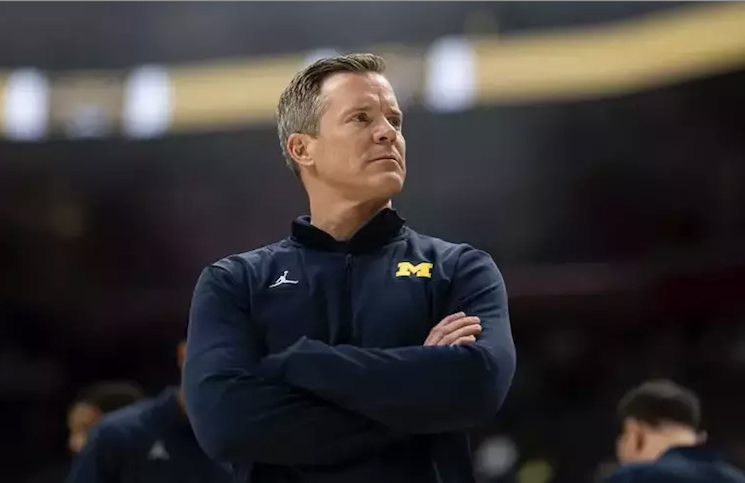
CHICAGO — Michigan head coach Dusty May met with the media Saturday afternoon before the Wolverines prepare to face Tennessee in the Elite Eight. The Wolverines are looking to punch their ticket to the Final Four in May’s second season and just three years after May took FAU to the Final Four.
Ahead of the matchup, May discussed managing the transfer portal, what stands out about Tennessee and much more. Here’s everything May said.
More From RTI: Tennessee Basketball NCAA Tournament Preview — A Quick Look At The Michigan Wolverines
On what he takes from facing Tennessee in the Sweet 16 three years ago
“There’s a few things that were great reminders. We didn’t show them any film. We try not to overload them. There were a couple lessons we learned.
We felt like the first 17 minutes of that game, we were completely overwhelmed. We were struggling to make passes. We were trying to do too much as individuals. Just before half, we made a couple of really good plays and felt like, okay, that’s it. There’s the solution now if we can carry that over into another half and play really good ball.
And we were able to do that and had a double digit lead with a few minutes left.
I think it’s just a reminder of it’s shocking how physical they are in a good way, how hard they play, how active they are with their hands. It’s very difficult to throw a direct pass anywhere on the court because of their effort. Obviously, their size, athleticism factors into that.
So, yeah, it was a good reminder to watch that edit because some things definitely popped back into my head to be aware of.”
On his comment about recruiting Yaxel Lendeborg and not disrupting seasons
“This time of year and this couple weeks, for example, you’re receiving calls and they sound something like this. So and so is — if they bring in this player, then this player’s going in the portal. If this player goes here, then that player doesn’t want to play with him, and he’ll probably leave. If this coach leaves this school, then this player’s going to go into the portal. Things like that.
And so usually, if you hear that rumor, then someone called last year and said Bennett Stirtz might go into the portal after the season. And this is probably maybe this time or a week prior.
So I called Ben and said, hey, is it true that Bennett’s going to leave next year? He said, I don’t think so. He said we’re going to do everything we can to keep him. If he wanted to leave and go to the portal, there’s only a few guys I would feel comfortable could coach him well. I’d certainly help that. No, I don’t see that happening.
Same thing with AK. I know Andy Kennedy. Someone called and said Yaxel had another year, the JUCO ruling. And just called AK and said what’s he going to do next year? Stay there, go to the NBA, enter the portal? I don’t remember what his initial response was. It was something like that.
You hear all this stuff going on. I’m sure half of our roster has — all of our roster has — everyone has representation now. So when a head coach, his season ends today and he takes the job tomorrow, he has an agent that’s been working those back channels.
And I’d say 90 percent of the good players have the same thing going on right now, whether it’s working the back channelling to stay and leverage to get more for themselves or doing what agents are paid to do to represent their clients. That’s what I meant by that.”
On freshman Trey McKenney earning the right to take tough three-pointers
“He’s earned the right to take those shots through his day-to-day work, his preparation. He’s shot them throughout the year. When Trey comes in, if we can generate this shot, an open 3, we want him to take it whether it’s 5 seconds in the shot clock or 25 seconds in the shot clock.
He’s an explosive player and he came in last night and got right to it. We needed it.”
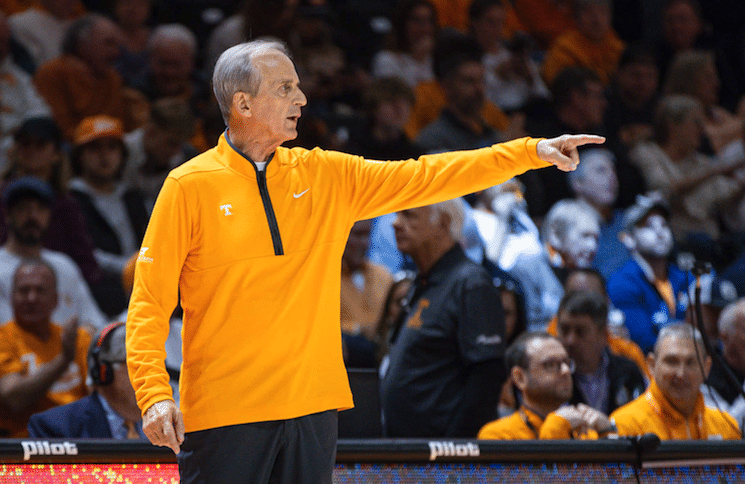
On Rick Barnes longevity
“Well, obviously, I mean, when you just look at three consecutive Elite Eights, in this era, the level of consistency. And when he got to Tennessee, I was assistant coach at Florida. So we saw how quickly he was able to get it turned.
They have the same identity. Every year, year in year out, they have the same base. Ryan Albert, now the athletic director at Georgia Tech, was the associate AD here. He was our associate AD sport administrator at FAU. When he left to go to Tennessee, I would call him, hey, what’s Coach Barnes doing this summer? What’s coach doing in preseason?
When I got the FAU job, I watched their pregame warmups and routines and just felt like that’s a team that’s really — man, they’re very intentional with everything that they do.
I called their strength coach and said do you have anyone in your tree I need to interview or query? I have a lot of respect with how your guys play, how well they move, how physical they are.
Also, there’s a different level the way they work and attention to detail. I’ve tried to absorb as much as I could from afar about his program. Couldn’t have more respect for him as a human being.
Chris Walker on their staff — I know their assistant coaches, they’re just really, really good guys who are great ball coaches. I actually started drinking Kombucha
Tea because Albert told me they have a Kombucha machine. If I can coach with the longevity of Coach Barnes, if there’s secret cause, maybe it’s the Kombucha.”
On Nimari Burnett’s defense against Tennessee’s guards
“Nimari is a stabilizer. Every day, he’s the exact same person emotionally, physically. His pre-practice routine is 10 out of 10. Everything he does is a lot like the Tennessee guys with attention to detail and purpose.
As far as athleticism, we’re going to need our guards to rebound well. The basketballs they can’t get, they’ll have to figure out a way to tip them to guys wearing our color jersey and away from the Tennessee guys.
He’s got length. He’s got size. He’s got athleticism. I think our guards rebounding down will be the difference in us moving on or going home.”
On Michigan’s roster reflecting his coaching experiences, identity
“We’ve always done it a little different. I watch certain teams that recruit a certain profile or certain skill set. We’ve always just really tried to find guys how love ball, who are great teammates, who are competitors. Those are probably the two things we value most.
Competitors because just we have a strong belief that competitors are going to figure out a way to win. Whatever that is, they’re just going to figure out a way to win whatever they’re playing. And so the competitive spirit is probably the most important thing.
And then loving ball would probably be a close, close second. Sometimes we say we don’t really care. You can love to compete or you can love ball. We think we can get to the end result as long as you have one of those.
And then whether — obviously, being big is in vogue. I’d never been a big coach at the Power 5 level. At Florida, because we were so big, our defensive numbers were top five in the country. I didn’t feel like we were that great defensively or had great defenders. Because we were big and athletic, that gave us a baseline to be good.
So we wanted to try to copy that. Then it was convenient because Vlad was 7’1″. And then Danny’s mom went to Michigan and he wanted an academic situation and high level basketball. That puts us 1 out of 5 as far as the academics and the basketball.
And then you have the family connections. We thought, wow, we could have a real shot at getting this guy. Two seven-footers, you’re naturally going to be bigger than most.
We’ve always tried to get good players and have enjoyed the process of watching our guys, learning our guys, to figure out the best way to function as a group. We’re not married to being big. If everybody goes big, we might weave and go small. Who knows? We’re not winning because we’re big. We’re winning because we have really good players and smart players.”
On the differences in sports culture across the country
“I think, obviously, there’s cultural differences in every region. I’ve lived in Florida. I’ve lived in the deep south. I’m a midwesterner. I’ve lived in L.A. I’ve lived everywhere but the east coast.
Everywhere I’ve lived, there’s a different culture in the way people live, the way they look at sports, the way they look at society. The Big Ten, you think about it, the University of Michigan was a university before Michigan was a state. So there’s a lot of just ingrained tradition that goes with being affiliated with Michigan. I can just speak for this school that I represent.
So you have 150 years of connection, if you have — if anyone in your family went to Michigan. I guess the culture of sport in the midwest, the farming communities, it’s cold all winter so you work in the summer and you work in the fall and you work in the spring and you’re inside watching hoops and getting ready.
So I think you have a long history of people loving basketball. You go in Big Ten arenas and these places are packed. I used to tell people all the time, our games in high school, we couldn’t announce our schedule until the IU schedule was done because they weren’t going to schedule a varsity basketball game at a small school in Indiana on a night IU played. That was sacred. You don’t schedule church during mass. You don’t schedule basketball during IU games.
Someone told me recently as long as our teams are playing for a championship and we’re representing something, a city, a university, whatever the case, then people are going to really care.”
On Michigan’s consistent offensive success
“Just continuing to create offense for each other, whether it’s through screening, cutting, passing, whatever the case.
I heard that stat earlier today, and I was shocked because I felt like we left so many points on the floor last night between our missed free throws and front ends and, also, our lack of conversion around the rim in the first half.
Because of our leads, all three games, we’ve slowed our tempo down the last 8 to 11 minutes of each game, drastically. So I think just our guys have found a good rhythm and our role guys are making shots. Our stars — I saw what Yaxel is shooting in March, and our stars have elevated their game as well.
I think all those things combined have allowed us to be efficient on both sides of the ball.”
On Elliot Cadeau’s leadership
“Well, he is vocal. Elliot, going out to the court when we’re at our best, his voice is heard. We actually made a comment, staff was watching film this morning, about how tough he is. He is an absolute Tasmanian Devil when he’s at his best. He’s impactful. He takes it personal.
When we were analyzing our team and evaluating our group this summer, we’re trying to forecast what could be a problem? What could keep us from being our best? One of the things we thought, we had two psycho competitors in Morez and Elliot, and we had to make sure those two psycho competitors weren’t competing each other. And found a way to make them realize they were very, very similar, so there could be some friction in practice, and as long as it never goes too far and doesn’t get personal, that edge will make us better. Those two guys, their competitive spirit.
You see Yax, he’s a fun-loving guy. He can turn it on and really compete at a high level. But Elliot and Morez are absolute psycho competitors, and our group needed that. So he’s brought that and he’s brought such a high level of intelligence to our group.
I mean, we have a couple guys that I call them savants. When I watch film with our young guys, I’m showing them clips of our older guys and say he probably doesn’t know what he’s looking at here. Let’s dig deep of what he saw there so we can learn from him.
We’ve learned a lot from Elliot. L.J. Cason has learned a lot from Elliot. Trey McKenney has learned a lot from Elliot. But he’s such an intelligent player.”
On Yaxel Lendeborg being a fun loving guy
“I embrace them all for who they are and try to just move the needle a little bit. When we look back to where he was to where he is now, he’s a completely different person. I think when we see him a year from now, when he’s playing in an NBA rotation, he’ll be a completely different person.
I think he’s a little bit misunderstood because he’s not nearly as self-confident. And I’ve even read where some have called him arrogant. That’s not who he is. It’s probably his defense mechanism. He’s as genuine a human being as I’ve been around.
There’s a video of Purdue about this or that. I was shocked by the video because it was so out of character. I’ve probably had too many drinks a few times and done things I shouldn’t have at a bar at 3 a.m.
He’s just such a good guy, awesome to be around. But as you hear our players talk about his level of unselfishness and never being above the group is what’s made this year more special.”
On Ja’Kobi Gillespie and Nate Ament
“We have the scout on Ja’Kobi. We played last year against Maryland. He’s dynamic. He’s got a clean shot from 27 feet, so he extends their range and their spacing.
His ability to get in the paint and find small cracks and crevices to create offenses is as good as anyone we’ve played. He’s smooth. He’s a smart player. He’s crafty.
We recruited Nate early on so I watched him play with his high school team and travel ball. He’s a special talent. He’s 6’10”. He gets to his spots. He shoots 3s. And I’m pretty sure one of the reasons he probably chose to go to Tennessee was to learn how to work to be a pro. He’s done that. He’s a completely different player than he was four months ago or six months ago, whatever the case.
Once again, that’s a testament to the culture of Tennessee basketball.”
On if tampering rules are clearly defined
“There’s so much hearsay. I don’t want to get into this because it’s — you never know if it’s leverage. I’ve heard we’re recruiting a player that’s a junior, and we can’t take juniors. So you try to address it, and you realize onces it’s on Twitter, there’s no reason to talk about it. Just let it go.
But even when we’re negotiating with agents, they’ll tell us, well, this school offered this, and this school offered that. I was talking to one of my closest friends in coaching. He’s had postseason meetings — they were in the tournament, got beat early, and he’s had postseason meetings. He said this guy’s been offered this from this school. You don’t know if it’s true or not because — if an agent is using leverage or maybe the agent called a coach he knows and said this kid is leaving, he’s just got to wait until the portal opens. Do you guys want him?
I don’t know. It’s really complicated, like I said. We had one of our player’s agents two weeks ago say he’s spoken with other schools. He caught himself. I said you work for your client. And we’ve got the next month to evaluate from our standpoint and his standpoint, if this isn’t the best place, there’s no hard feelings. You work for him. You have to do the best for him. We want him to stay. If he doesn’t feel like he’ll have an opportunity to play and develop, whatever the case, there’s no hard feelings.
So he was almost shocked that we weren’t angry at him because he said he’d spoken to several other schools. So it’s — as long as they’re all on one-year contracts and as long as there’s as much fluidity as there is in college basketball, until we figure out a system, it’s not going to change. I don’t take it personally when our guys say they have offers from other schools. I just don’t.
I don’t like it because, obviously, it’s more work for me and it’s change and it’s hard, but I’m not mad at them for it.”
On facing Tennessee’s physical front line
“I don’t know. There’s going to be a lot of good big guys on the court for both teams tomorrow. We’re at the point of the season now where we’ve proved we’re able to win no matter how the game goes. Slow, fast, physical, free-flowing.
So we try to figure out how the game is being officiated, what the rules of engagement are, and try to do the best we can. We feel like we’re built to win and play whatever it is. We feel like being adaptable is a strength.”