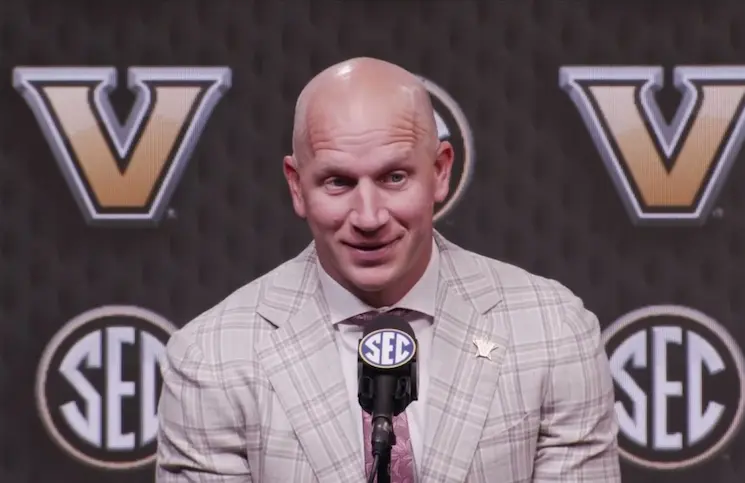

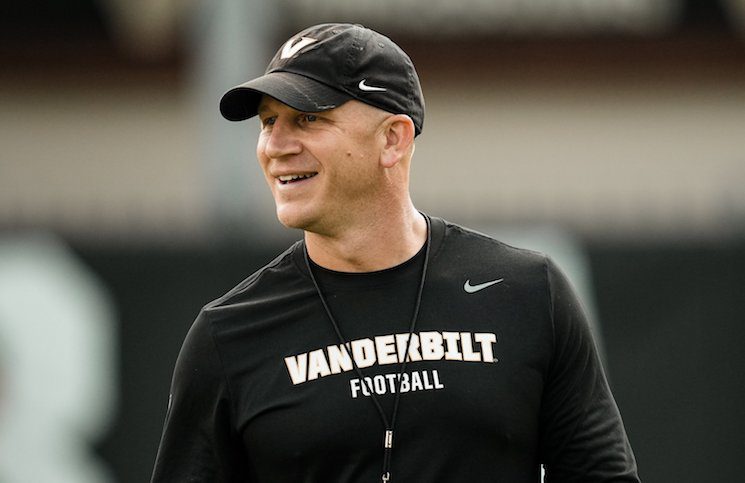
As 2026 SEC Media Days rages on, Vanderbilt head coach Clark Lea took the podium on Tuesday afternoon. He is coming off his best year yet leading the Commodores, but is now looking to find success without quarterback Diego Pavia.
Lea was asked about the quarterback position, his run game and more. Here’s what he said.
More From RTI: Kentucky Head Coach Will Stein Takes Opening Day Headlines With Bold Statement at SEC Media Days
CLARK LEA: Well, it’s great to be here representing Vanderbilt University. Over the last five years through the efforts of our players and coaches and staff, through the commitment of our leadership, Chancellor Diermeier, Candice Lee, and our Board of Trust, and with the support of our NIL partners and alumni, Vanderbilt football has become something different.
We’ve been learning what winning requires, what winning demands, and what winning can mean for our university and athletic department and entire community. It’s been a remarkable journey, and I’m incredibly grateful to everyone who has had the courage to believe in our vision and walk beside us along the way.
I’m especially grateful to our players, those who chose to stay and fight together, to build something meaningful while the world laughed from the safety of the sideline. I’m indebted, and I’m inspired, but let me be clear, progress is not the destination. Last season was not an arrival. It was simply another step in the climb.
Our objective remains what it’s always been, to build the best football program in the country. While progress is encouraging, complacency is dangerous. The moment we turn to protect the ground we’ve covered, we stop our pursuit of what’s possible at Vanderbilt. We must be willing to risk what we are for what we could become.
Now it’s Team 6’s turn. Every season has its own form. Every team writes its own story. Naturally people want to compare this team to last year’s team. While there are similarities, there are also important differences — different players, different coaches, different leaders, different personalities, different strengths, different challenges.
Despite these differences, this group has inherited something that previous teams did not: A Vanderbilt football program that expects to win.
With that inheritance comes standard over excuses, responsibility over entitlement, commitment over convenience. That inheritance gives us a foundation, but our story still must be earned because this team has yet to win a game. That’s the gift of every season. A new beginning, a blank canvas. Every team has to forge its own identity. Every locker room develops its own chemistry. Every season asks a different set of questions. Every team has to write its own story.
Stories are written from the inside-out. That’s why in every step we must tend to the internal with great discipline and focus. This message is as important today as it was five years ago. We cannot allow our program to be defined by the past or by anyone on the outside. Not by last season. Not by preseason rankings. Not by media expectations. Not by praise. Not by criticism.
We’ll be defined by who we are, by what we choose to do and not to do every day, when we step onto the practice field, when we gather in the meeting room, when we walk our campus, when we serve our community, when no one is watching, because whole-hearted devotion to the discipline of Sunday through Friday becomes the privilege of performance everyone sees on Saturday.
Inevitably people will spend the next several weeks predicting what this team will become. That’s just a part of college football. The truth is none of us know the story yet, but I do know this: Over the next six months, we will write it in our choices. If we choose to stay committed to who we are, we act with courage, if we remain faithful to one another and disciplined in our process, we will write a story worthy of Team 6. Because the true value of this story is not in how it’s remembered. It’s in who we become along the way.
Thank you.
THE MODERATOR: Thank you, Coach. Questions.
Q. It feels like Vandy has been the underdog that every SEC fan can root for these past couple of seasons. This year it kind of seems like you’re almost out for blood to make the playoffs after missing it. Is that something you feel as well? How are you getting the players to buy into it?
CLARK LEA: Well, I think we’re still internally the chip-on-the-shoulder underdog that has a lot to prove. Again, there’s nothing that we inherit from last season that has to do with any future win. Everything is about the responsibility we have over the program that we have built, but how this team can actually move it forward, and maybe more importantly, how this team can fully express itself over the course of the next six months.
You know, we don’t spend a lot of time on external narratives. I think my hope would be that the program with every year becomes a little bit more of a thorn in the side to other SEC fan bases, but all that said, we’re going to spend time focusing on what we can control and the things that we do, the responsibility we have to turn our attention to the work that hopefully will give way to the potential of this team.
Q. I wanted to ask you a two-parter. First, about a couple of your portal additions, Cole Adams and Micah DeBose, from the University of Alabama. And then, my community, of course, we’re very honored, Candice Storey Lee grew up there, played high school basketball, and now has become one of the best athletic directors in the country. Talk about your relationship with her and how it’s helped your career at Vanderbilt.
CLARK LEA: How much time do we have left? Because I want to talk a lot about Candice Lee?
Let me start, out of respect for the question, Cole and Micah both have become really special members of our team and our program. I think they’re at different points of their career. Both are misfits in their own right. They’ve been welcomed and created a sense of belonging for themselves in our locker room. It’s been fun to watch them take ground as members of our team. We’re privileged to have them. I know they feel a part of this program and what it’s becoming.
With Candice, you’re talking about outside of athletic directors, maybe the single greatest leader certainly that I’ve been around. There’s a human and emotional element to this that she understands that I think is lost by so many.
The thing that I can point to, first of all, she doesn’t get enough recognition. You talk about someone who has been a part of Vanderbilt for a long time and yet has the courage and vision to see the future as something different.
She’s locked in arms with Chancellor Diermeier. They’re so aggressive in where they want to take this. It’s not just about football success. Her vision, her leadership has unlocked potential in a lot of other programs, too.
She is unique, but I would share this with you as kind of — well, I mean, aside from all the things that she connects with within our program and the personal relationships she develops with our players and the way those relationships give way to energy within our building, in 2023 when we were going through a really challenging season, I think 99% of people would be marching down the hallway to point a finger at the football coach and say, “You got to get this fixed,” I can’t express how supportive she was and how much of a partner she was in those hard moments.
She is so tough. I mean, here’s someone who has overcome every odd and still has to fight down and beat down all these external labels that get placed on her. All she did in that tough moment was be at her best.
I’m grateful for that independent of what this program has become because of that level of partnership and leadership. I’m grateful for the example she showed me of what that looks like.
Again, I could take the rest of the time talking about Candice. She’s the best of the best, and I hope that the world is paying attention to what she’s doing because I think it’s important. There’s an important thread that needs to be pulled into our society more broadly.
Thank you for that question.
Q. Just wanted to talk about the running back game and how different this offense is going to look without Diego Pavia. I know it’s an understatement to say that he did make this offense look a little bit different than what we’ve seen in the past.
CLARK LEA: Well, first of all, you’re from Huntsville. Do you want to talk about Candice Lee? Because I’m happy to talk more about — okay (smiling).
I appreciate the question about the running back room. I think there is so much attention being given to how this offense will take shape, specifically who is going to take the snaps. Though that is an important question, what I’m more interested in ahead of training camp is how is this team strengthening in all the other areas that will support that position?
You know, the mission is winning. That certainly hasn’t changed. Does winning look different from year to year? Absolutely. It’s our job to pivot and adjust and to unlock the potential of each team.
What are we going to do defensively? How are we going to perform better on third down to generate more possessions, to limit snaps, to limit points, and to get opportunity to an offense that I know is going to have the ability to move the ball?
In special teams we’ve been really strong over the last few years. Jeff LePak does an incredible job. What are we going to do with our punt return unit? We got Martel Hight taking the punt returns. Obviously Cole Adams has experience with that, too. We didn’t unlock the potential of that unit last year. When you talk about punt return, you’re talking about establishing field position, taking some pressure off the offense.
Offensive line play, I think we replaced a lot of snaps with a lot of snaps, and I think we feel really good right now about where that group is. And I have total faith and confidence in Coach Klenakis and Jeff Nady who are helping to lead that room.
How are they going to win the point of attack and establish a line of scrimmage dominance that allows for this run game to get going? Because Seddy Alexander and MK Young are two of the best, most talented backs in our conference. If all of a sudden these things are falling into place and we’re strengthening in those other areas, you just lifted burden off the guy that’s taking the snaps.
Now, the offense will be different, right? Tim Beck has proven his ability to adjust and adapt. Look at 2024. You’re going to see an offense that looked like an option team, and we were grinding out clock and shortening games. That’s how we won.
You look at last year’s team. You’re going to see an offense that absolutely exploded in the opposite direction, right? We went with tempo. We threw the ball vertically down the field. That is both Tim’s vision, and that is Diego’s growth.
I think all those things are signals of program strength. The running back room is going to be a big part, but again, the guy carrying the ball is only as good as the people moving the line of scrimmage. If we can establish a great run game in front of the quarterback, I think that we take pressure off, and we allow the ball to be distributed to the perimeter in ways that we can become the explosive team that we’ve been.
All of that is out in front of us. I’m excited for the challenge. I know the team is ready to redefine what winning is going to look like, knowing that certainly we’ve got a big gap to close. We have a bunch of guys that have been working in the shadows over the last few years that will finally get spotlight turned to them that I think will be good for Vanderbilt football.
Q. You mentioned that 2023 season ended with a whole bunch of big losses. Then you had a whole bunch of players that jumped into the portal right after that. As you think back to that week or two after that season ended, what were the thoughts that were going through your mind at that time? What would you say are the key adjustments or decisions that you made back then that allowed you to have a ten-win season just two years later?
CLARK LEA: I think some of those thoughts aren’t probably appropriate for this stage. No, I mean, that’s called getting your ass kicked. When we endure that, it’s painful. In reflection, you realize that may have been the most important thing that’s ever happened to me as head coach and to the program, you know, in terms of what we’ve been able to grow from that point.
But I think if I were going to land on any one thing that I kind of kept circling back to, obviously I’m the one that stands on the stage and at the podium, and I have the microphone, but the story of our program is about way more than me. It’s about in those moments the efforts of so many people who believed in the vision that I held near and dear, too. Even though we felt a distance away from that vision, the vision never left us.
People who couldn’t get on board with that vision did leave us. This program’s momentum wasn’t built by those that needed to be convinced to believe. It was the ones that saw it for themselves and chose to believe despite what the world may have said about where we were.
For me personally, I just kept coming back to what I knew to be true about Vanderbilt. This is that we’re one of one. You have a top university that’s only gotten better. The reach of our Vanderbilt University brand has only gotten greater in the last few years. Credit to our chancellor. So you have a world-class institution in a world-class city playing in a world-class conference.
That’s the starting point. That’s the foundation of something that I believe and I believe in the moments, even the hard moments, that inevitably would lead to a program that could elevate success, that could redefine what it means to be a college football program in the modern era.
So with that belief and heart, in those hard moments you have to force yourself to say, okay, you know, in 15 years, when I look back on this moment, what is it that I’m learning right now? Not that I’m feeling right now, but what am I learning right now that’s going to lead to those pivots and adjustments that’s going to unlock the potential division that I have and I share with so many that were, again, in the bunker with me?
That attitude is what gets you off the floor, and that attitude is what gets you to step into the next punch. It’s just we say in our program head-body, head-body. It’s this continual willingness to occupy the ground that your feet are on and to focus on the next punch.
Through that, you know, we were able to make some important systems adjustments. I think about in strength and conditioning, I think about taking over the defense, and I think about hiring Tim Beck as three critical points of change.
That gives way, then, to Steve Gregory, who now is elevating his performance as the defensive coordinator.
I think about, again, Candice being in that bunker with me and saying, Hey, what are the things we need to do departmentally to unlock this vision? So she had my back in those moments. We collaborated through that time really well.
Eventually, you know, I get to be up here coming off a successful season, but just to go back to what I said in my remarks, you know, progress is not the destination. The objective hasn’t changed, and five years ago I talked about building the best football program in the country. I stand here today echoing the same message. We’re not finished.
Q. You talked about your running game a minute ago. You ran it pretty well last year, but a lot of teams didn’t. Alabama, LSU, Oklahoma, Texas, none of them could run the ball hardly at all. Is something going on in college football that makes it difficult for teams that traditionally can run it well to just hit a stone wall?
CLARK LEA: I want to stop short of commenting on any of those programs. I think everyone is trying to find their unique path to winning. Obviously we talk about running to win in our program. We place an emphasis on the physical aspects of that, and that’s both in running the ball in offense and running the ball well on defense. Both are important to us and to our program.
Everyone has a little different formula, different approach, but you know, Vanderbilt football is about a physical style of play. It’s about an effort, an attitude. That’s the starting point.
A lot of this was kind of born out of the idea that we wanted strategically to shorten the game.
We wanted to be able to impose our will in the second half and protect the lead. I think last year it became more about how we’ve become explosive and win games on offense.
The difference — and this is why this becomes such an important conversation around Team 6, is if you look at our offensive production last year, the number of carries that went through the quarterback position, you know, obviously that will change this year. Here’s our opportunity to say, you know, Vanderbilt football runs to win, and we’re going to establish this run game through a running back room that we feel like is as talented as any in the conference.
That’s a challenge that I delivered to our offensive line and to our running back room, and I know they’re excited to answer that challenge ahead of us.
Q. What are some of the challenges that you have faced so far replacing Diego Pavia this year, not only as the Heisman runner-up, but also as a leader in the locker room?
CLARK LEA: Well, we won’t replicate Diego. He’s unique in so many ways. Gosh, you know, to take just a moment and talk about how grateful I am to have coached him, to have had him be a part of our program for two years, then to pivot and say, you know, there are a lot of guys that have been working in the shadows doing all the little things that leaders do that haven’t had the spotlight turned on them.
Now it will be, and now it’s their turn. We inherit the standards, the culture, the attitude, the expectation to win. We don’t inherit any one result from our past. So this group has to build its own chemistry. This group has to define its own identity as a team.
To say that we’ve done that to this point, I’ve been pleased with our work, but I think we have ground to cover yet. I’m talking about to represent what 2026 Vanderbilt football will look like, but I know we have the pieces to do it.
So as we wrap summer up over the next couple of weeks as we turn our attention to training camp, we want to run to the hard places as a program. I want to make this as challenging as I can possibly make it so that we can kind of burn off the impurities and allow those guys that are ready to take that next step in leadership, allow them to rise.
It doesn’t have to happen through the quarterback position, but we have some guys in that room that are ready to step in and to lead in their own right. This is the great challenge. This is the great unknown, and it’s a part of the story that I’m excited to write alongside our staff and our team.
Q. The new five-for-five eligibility rule that’s going to be in place, just how does that change your recruiting? How will that help you continue to build Vanderbilt?
CLARK LEA: Well, first of all, I think it’s a great thing for our sport. It allows for developmental approach while also playing on the field.
When you talk about fielding a team with roster limitations now, you unlock a possibility of every program member for the duration of the season. I think that is a big deal.
So guys in the last couple of years that have had smaller roles, maybe played on a couple of special teams, but they were impacting winning, they retain that year, so they can apply their experience for a fifth year. I think that’s fantastic.
It’s also going to lead to conversations after the season with guys that have exhausted four years of eligibility and are aimed towards NFL careers, but have the opportunity to return. I think those will be important conversations as well as we look to best position the program moving forward.
You asked how it changes our strategy. I don’t know that it changes. I think it unlocks potential in each roster because there are more people you can access to impact winning. It reinforces this developmental approach.
I still believe at Vanderbilt that to have a player in the program for four or five years is our best bet to build the kind of program we want to be. That’s not to say that we’re not every year going to go and look to strengthen through the portal, but to get back to high school recruiting and to really focus on kind of building the program from the ground up and leaning on, again, third-, fourth-, and fifth-year players is really exciting to me about not sustaining, but elevating the performance of our program.
Q. I wanted to ask about the AFCA, in particular now that you’re the president of it. In terms of we just got through celebrating five years of NIL, but your job in particular, how united are coaches in particular, be it tampering, portal, you name it, in terms of the challenges to do your job?
CLARK LEA: Look, first of all, this is a great moment in college sports. I think there are so many people that may say otherwise, but I think we are living through a moment that will always be remembered for all the things, all the changes that are coming to be. Has it created challenges? Yes, but what in life is worth doing that doesn’t have a great challenge?
There’s a lot about what we’re experiencing I think that has brought the coaching community closer. Yet, we’re all responsible for our programs, so we’re doing the best we can within our roles as head coaches.
I have been really impressed with the willingness of head coaches, particularly in the FBS, particularly in the autonomous four conferences to come together and to collaborate. I think we’ve had really interesting conversations.
Yet, we only control so much of this. I think with every year that goes, you kind of realize how little that control is. I think it’s important for us to continue these dialogues, this community that’s growing and building.
I think we need to focus on the change that we can have. I think we’ve done some important things with this five-year eligibility rule, with recruiting calendars and dead periods. We’ve strengthened the game in a lot of ways.
We need to continue to focus on ways that we can strengthen the game within our roles and also then shift to how we lead our programs with integrity and focus on the goodness in the game.
That’s our challenge. Sure, there are days where you get frustrated and you want the quick fix, but this is not going to be something that’s solved overnight. I think we’re doing really well navigating through it. Even though the game looks a little different now than it did five years ago, I think in so many ways it’s improved.
So let’s keep focusing on that incremental improvement. Let’s support the people that are in positions that can help enact the big change, but let’s focus on the small change we can have day in, day out with our teams.