
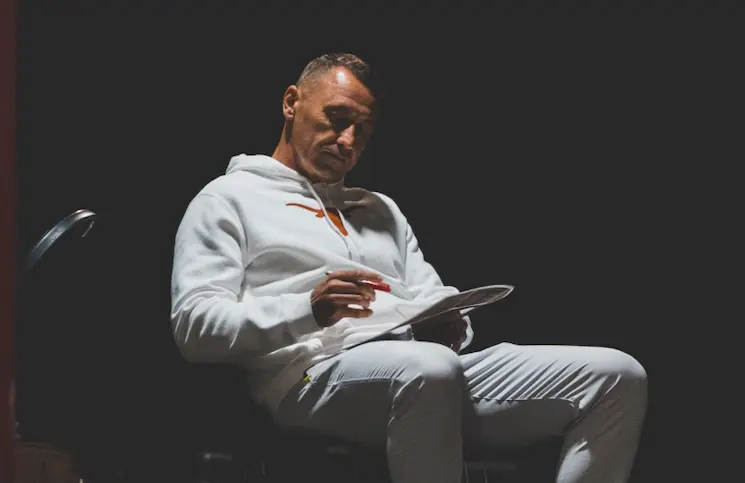
2026 SEC Media Days is finally in the books. The last of the 16 head coaches in the conference to speak was Texas football’s Steve Sarkisian on Thursday evening.
Sarkisian discussed his schedule, quarterback Arch Manning and more. Here’s what he said.
More From RTI: Tennessee Football Lands Two Expert Predictions For Talented In-State Running Back Asa Barnes
STEVE SARKISIAN: Good afternoon, y’all. They say they save the best for last, right? I know y’all are ready to go home, so I’ll make it brief. No, I’m just kidding.
First of all, just some thank yous before we get going here. First of all, I’d like to thank Commissioner Sankey. I know his job is not easy, and I know in the midst of college football today and college athletics, there’s a lot of change, and there’s a lot that goes into his job.
I can tell y’all from sitting in rooms with him and a lot of phone calls, he’s trying to do what’s best for our sport. Not just for the Southeastern Conference. He really is trying to do what’s best for our sport.
I’d like to thank the leadership at the University of Texas, you know, chairman of the Board of Regents, Kevin Eltife; Jim Davis, our president; and our athletic director, Chris Del Conte. I know a lot of people talk about alignment, but we are truly aligned. That was something that six years ago when I took the job, one of the reasons why I took the job was the alignment, but it’s shown and shown through time and time again.
The job that Chris Del Conte has done at Texas has been nothing short of remarkable. Won five of the last six Directors’ Cups, and just the absolute strength in every sport in that entire athletic department is something that I know he’s proud of and we are all very proud of to be part of.
I’d like to thank our staff. Our staff is doing a tremendous job. These guys, it’s men and women, are working extremely hard not only on the grass with our players, but in the building, in the meeting rooms, in recruiting, being on the forefront of doing things that have never been done before.
And just proud of the work that they do on a daily basis. It’s a demanding profession. It’s a demanding job. And their spouses, their families, the sacrifices they make for us, for me, for the University of Texas doesn’t go unnoticed. Thank you all for what you do.
I’d like to thank our fans. The support that they give us is tremendous. Longhorn Nation has just been phenomenal. I don’t think people know this, because I think people think about home field advantage in tough environments to play, we’re 20-1 in our last 21 home games at DKR. And that’s a direct reflection of our fans and the support that they give us. Thank you for your support in all that we do.
Commissioner Sankey touched on a few things and a few stats that I’m really proud of our program and our organization and what we’ve been able to accomplish.
You think about last season alone, we beat three top-10 ranked teams in a down year. The last two years, we’ve beat ten top-25 ranked teams, which is more than any school in the country. I believe it’s 14 wins over top-5 teams over the last three years.
There’s a lot to be proud of for us at the University of Texas. But I will say this at the University of Texas. The standard is the standard. The standard is the standard. And I know the expectations are hire outside of our building. I know everybody wants to say what percentage we are to make the playoffs or what percentage it is for us to win a conference championship or make the CFP or be a national champion.
But the expectations are always high within our organization. They’re higher than you would imagine. They’re higher than they are on the outside world.
Now more than ever external factors don’t motivate us. It’s what we’re doing internally. We’ve got a very hungry football team. We’ve got a team that competed their tails off a year ago and fell short of making the College Football Playoff after the previous two years being in the semifinals and knocking on the door to play for a national title with the ball inside the 10-yard line.
Those external factors, whether it’s a comment or a tweet or a podcast or an interview by a pundit, that’s not going to motivate us. What motivates us is what we do every single day.
I’m proud of the leadership on our team for buying into that idea, and I couldn’t be more proud of the guys for the way that they handle themselves that way. Because we’re going to have to. Our schedule is real. Okay? It’s a real football schedule.
I think the key to that is focusing on us, be enamored with what we do. That takes great leadership, that takes great commitment, okay, and that takes great mental and physical toughness to make that happen.
We’ve got three players here that I think exude all of those three things. Obviously we’ve got Arch Manning here. We’ve got Colin Simmons. We’ve got Trevor Goosby.
The first thing I’d like to say about those three guys is all three of them signed with the University of Texas out of high school. So in this era of transfer portal, in this era of players coming from different places and building rosters and so on and so forth, these were three guys that chose to be part of our program when maybe our program wasn’t where it is today.
Arch and Trevor came four years ago. We were an 8-5 team coming off of an Alamo Bowl loss against Washington. They chose the University of Texas. Colin came the next year, but I think all three of these guys exude the leadership that is needed, the commitment to the program, the commitment to their teammates, and the mental and physical toughness to be a champion.
So proud to have all three of those guys with us today. I will say this, I know you all say it, but I’m going to say it. We do have a talented roster. We do have a good football team. We’re balanced. You know, I think we’re good on offense. We’re good on defense, we’re good on special teams. I’m not going to shy away from that to give you the coach-speak.
We do have a talented team, but we’ve got to make that come to life on every single Saturday against a challenging schedule, and that’s the challenge as their coach is to get them in the right mental space, the right physical space to go out and be at their best when their best is needed. In our conference and in our nonconference schedule, that’s every single Saturday.
How did we build this talented roster? We built it through retention. We kept really good players on our team. We built it through high school recruiting, all right? We signed a heck of a high school class, which I think we’re very proud of that class, and we built it through the portal. That’s a credit to our recruiting department of making those things come to life.
You know, we lost 40 scholarship players off of last year’s team: 24 portal transfers, which was more than we ever had; three early NFL Draft picks; and 13 seniors.
With that, we brought in 47 new scholarship players: 22 through the portal, 25 freshmen.
So a lot of new faces.
Culture is a big deal for us, but our culture gets developed historically in the summertime to get ready for a season. I failed our team a year ago by doing it that way, and I felt like we didn’t have the culture needed early in the season to make that happen, to be the team that we were capable of being. I learned my lesson.
We started doing our culture work in February this year, and I think it’s paid dividends. (Audio Interruption.) They all said, man, I love how summer’s going, I love how close we are as a team.
These guys were doing a scavenger hunt yesterday, and Colin and Arch were competing until the end. Their two teams were the one at the end racing to win it. Everyone is sweating bullets, it’s 100 degrees in Austin right now, and they’re having a blast together as a team.
Those are the moments that are going to get us through the tough fourth quarters. Those are the moments that are going to get us through some tough road games of where we’re headed this fall. Proud of those guys for buying into what was going to be so important to this team.
We are not a finished product. We’ve got plenty to improve upon from last year. It goes without saying, we’ve got to become a better run football team. We did not run the ball to the standard and the capabilities of what it is at the University of Texas.
Now, we can make that better a variety of ways. You got to get better up front as an offensive line group. You got to have capable runners that can do that. You got to provide weapons on the perimeter that people have to deploy to guard against. And you’ve got to put schemes together that they can operate and do at a high level.
I think we’ve addressed all those areas in the run game. We’ve got to create more explosive plays. When we’re at our best, we’re in a very explosive offensive football team. We were not that a year ago compared to where we were two years ago.
The run game is a huge component to that, but we’ve got to become a more explosive football team, and we’ve got to minimize the penalties. We’ve got to fight the urge of playing behind the chains. I say fight the urge because I think there’s an urge to some of the penalties that we get.
We’ve got to minimize those penalties. All of that we’re talking about consistency on the offensive side of the ball. To me you put all those things together, we have a chance to be a very good offensive football team, but we’ve got some areas for improvement come the fall that need to show themselves.
Defensively obviously we’ve hired Will Muschamp to be our defensive coordinator. He’s been a great addition. It was everything I thought this hire could be. You know, Will and I philosophically are very similar. We believe in a style of defense that is in your face, that is tough, that is hard-nosed, but yet — and we believe in coaching hard, but yet, we believe in having a relationship and rapport with the players on the team. And Will does that. It’s been great having him.
Now, where do we need to improve defensively? We have to create more havoc. We have to create more negative plays, and we should have the capability to get that done.
We’ve got to minimize the explosives, all right? So making sure especially in the pass defense that we minimize those explosive plays. And then we’ve got to be even better on third down. And most notably we’ve got to be better in the red area especially on third down. So some areas of improvement for us there.
But I think this: I know there’s been a lot of talk, guys. I’ve been sitting at home watching the three and a half days of this stuff, too, okay, so I’m hearing everybody talk about the same thing. I can’t wait to hear the same questions get asked that you were asking Kirby three days ago.
I think this about the SEC: We’ve got a nine-game conference schedule. The challenges week in and week out, making sure that our football team is mentally and physically tough enough and prepared to play because that’s what’s required in this conference week in and week out, because if you’re not, you will get beat.
It’s not about beating us one time. It’s about beating us the nine times. That’s the challenge of this conference, and that’s what we will prepare our team to do. Looking forward to the opportunity. It’s a heck of a schedule, and couldn’t be more excited just about this team and about where I think this team can go.
Just a couple of things of note, housekeeping things. Cole Hutson, which y’all saw the temporary restraining order on the five for five, that’s still up in the air. I don’t have much more to say about it. We’ll see how that goes.
Then one addition for us, John Meredith will be an early enrollee for us. He’s reclassified. He’ll be with the team this fall as a great player for us, a DB, that we couldn’t be more excited to have on board with us.
With that, we’ll open it up to questions.
Q. Just wanted you to talk a little bit about the wide receiver room, Ryan Wingo, as well as Cam Coleman as he was added during the offseason.
STEVE SARKISIAN: Yeah, we love our wide receiver room. I think all those guys are 6’2″-plus. All those guys are over 200 pounds. They’re physical. They’re fast. They’ve all played a lot of football. When you think about their careers, obviously Ryan will be in his third year with us in the program, knows the system, knows the scheme. Really came on last year.
I think people forget he was a Second Team All-SEC receiver a year ago. Very explosive player.
Emmett Mosley came to us last year after his freshman year at Stanford where he caught 50 balls. He was injured the first part of the season. Really came on the second half of the season. He is playing at a high level for us right now.
Then the addition of Cam Coleman has been a great addition. You know, the thing about Cam, everybody sees the highlight plays, the play-making ability, the physical ability that he has. What I love is the person. This guy is a great human being. He’s a guy that is a great teammate. He’s one of our hardest workers. I think he’s been a great addition to that room, to that offense. I know he’s got good rapport with Arch. So excited to have him.
Q. Arch Manning, the name on the back of his jersey brings as much notoriety as the one on the front. How did the growing pains of last season — how would that benefit him this year?
STEVE SARKISIAN: I’d like to touch on that. You know, Arch Manning a year ago wasn’t on social media or on television saying I’m going to be the first pick of the draft. He wasn’t on television saying I’m going to win the Heisman Trophy. All he did was work really hard. All he did was try to be the best teammate he can be.
Then we had some failures as a team. He didn’t play to the way of what he was capable of playing. Then those same people that were saying that about him wanted to criticize and demean him almost for letting them down because he didn’t live up to what they thought he was going to be. Very interesting concept right there.
I think the way of what he got put through probably would have melted or destroyed 99% of people in his shoes. All he did was stay consistent and true to who he was, which was to continue to work hard, continue to be a great teammate, try to get better, and he did.
He came out and played the second half of the season at a really high level. We go 7-1. He’s got 20 touchdowns, only two turnovers. He’s a fantastic player at the end of the year, but he didn’t go back on social media and say “I told you so.” All he’s done this year is continue to work hard again.
There’s always going to be outside opinions of that guy, and that comes with the territory. He understands that. But I think he learned a lot about himself last year about dealing with adversity and overcoming. I think he learned a lot about his teammates and the support that they gave him and them recognizing the mental and physical toughness that he has to play the position, to be their leader. I think that he’s grown into a great leader for us.
I’m very proud of Arch for the way he’s carried himself, the way he represents the University of Texas. I think right now he’s a very dangerous player because he learned a lot from last season, and he is surrounded by some good players. I think that he’s a guy that’s poised for a heck of a season.
Q. What does playing on time actually look like for your quarterbacks?
STEVE SARKISIAN: Well, everything that we do is a progression-based offense. So you have a first read, a second read, a third read, a fourth read, so on and so forth. Those reads are basically tied to his feet, right? Whether it’s a quick game, an RPO, a drop-back pass, a play action pass.
So being on time is, when that read is available to throw the ball to, the timing of his drop marries with where he should be. If it’s a drop-back pass on his fifth step, is his first read open? The ball comes out. If it’s not, he hitches to his second read and then hitches to his third read, so on and so forth. That’s what it looks like.
I think the one thing that we saw real development in Arch a year ago, if you watch his pocket presence and the way he moves in the pocket, he moves like a pro. He didn’t have very many clean pockets last year. It was tough. We weren’t great around him.
Man, the guy worked at his craft in the pocket. And then the value of that was when he got some better pockets later in the year, he was able to take advantage of it.
Q. Steve, you’ve told us that you didn’t feel like your team was rewarded for playing in that big intersectional game at Ohio State. I was curious, where do you feel like that is as far as other schools scheduling attractive nonconference games? Are you still planning on playing Notre Dame in ’28 and ’29?
STEVE SARKISIAN: I think that that’s always a — it’s always a tough topic because I try to move on, right? We’re in 2026, but I think back to 2025. We have to learn from history.
You know, I have to go back to 2023 really. We beat Alabama at Alabama, and that might have been the game that probably got us into the playoff that year in a four-team playoff. We played at Ohio State last year — or, excuse me, we played at Michigan the next year. I’m not saying that was the game that got us in, but it surely played a part, right, of getting us into the 12-team playoff, and it got us a better seed, winning that game.
Last year we didn’t win the game at Ohio State. So I’m torn because I have two thoughts on this. One is if we beat Ohio State last year, surely we’re in a much better position when it comes to the playoffs, but on the other side of it is, if I don’t play Ohio State and I play Jones Junior High, and we’re 10-2 and our two losses are to Georgia and Florida, we’re a playoff team.
But like anything in this world, if you want to be really good at something, you got to take risk. There’s calculated risks involved in life that you have to take. It’s no different than playing quarterback. You got to take some risks at times. There’s no different than being a play caller. You have to take that risk. There’s no different than investing in a company or not. You’re taking a risk. And so, yes, there’s risk involved in playing a high-level nonconference schedule, but there’s a lot of value in that win. There’s a lot of value in that win if you can get the win.
So is the juice worth the squeeze or not? That’s what we’re all tasked with. So I don’t know yet about Notre Dame. We’ll see, because I think the committee has to show us what happens now and what’s the value that they’re placing on strength of schedule and are we going to let a 9-3 team in as an at-large? We’ll find out, and I think this year will be a great test to that of what that looks like.
Q. I’ve wanted to ask you just in the sense of chase. I know you say you don’t listen to the media pundits and —
STEVE SARKISIAN: I love you guys.
Q. — and what we say and the polls. Essentially given that Georgia has won the conference the last two years, is that the team that the conference and yourself are still chasing after as the top team currently?
STEVE SARKISIAN: You know, there’s a lot of sayings and quotes in the sports world in particular, but this one probably is the most fitting. “If you want to be the champion, you got to beat the champion.” It’s no more fitting for us.
We’ve played Georgia three times. They’ve beaten us. All the credit in the world to Kirby, their team. They’re tough. They’re good. If we want to be a champion, I’m guessing we’ll probably have to beat the champion to make that happen.
Q. Going back to the news you just, I guess, broke, what does John Meredith bring this team? I’m not sure when he turns 18, but can someone that young contribute at the cornerback position right away?
STEVE SARKISIAN: Yeah, he’s already turned 18. Turned 18 a couple of weeks ago. You know, he provides great length, great speed, tremendous man-to-man ability, very confident, very aggressive. All the attributes you want in a defensive back. It’s not a secret why he was a top-2 or 3 player in the country in the 2027 class.
So for us to get him now, we’ll see how far we can take him. Like I told he, I told his mom, Coach Muschamp, Coach Orphey, we don’t have an expectation on him of a timetable. We’re going to coach him. We’re going to develop him. When he’s ready, I think he’ll be good enough to play. How long that takes to get him ready? That’s going to be the race. That’s the challenge.
Week 1, Week 4, Week 8? I don’t know. I do know he’s got the right competitive spirit. I do know he’s got the skill set and the ability to be a good player for us. How long it takes, we’ll find out.
Q. You said that you began emphasizing culture work back in February because you thought there needed to be some changes from last year. As you’re entering your sixth season leading the program, a lot of people would think that culture is already well established. So what led you to think that additional culture work needed to be done, and what specifically did you want to see change from last season?
STEVE SARKISIAN: Well, I think this: We have 47 new faces in our locker room, so they don’t have anything established in our culture. We have to get them ingrained into our culture. That’s why we backed that up to start that process to get more guys ingrained sooner.
We do a lot of work. We do things called “Culture Wednesday” around our building where we tap into the person, the whole person, and we get authentic. We get transparent. We laugh. We cry. We hug. We write note cards to one another because we have to become a connected football team. That’s what gets us to where we want to go and through those hard times.
All the way to fast forward to yesterday, we did a scavenger hunt, and we broke everybody up into teams, and they did a scavenger on the 40 acres. It comes down to Arch and Colin’s team sweating, competing at the 50-yard line at DKR, and they loved it. That’s the stuff that we’re doing now sooner than maybe we would be not doing that maybe until the end of training camp.
So I think it’s going to benefit us. I think the connectivity these guys have right now is huge, but why? Because we got 47 new faces when historically you would have about 20 or 22.
Q. You talked about a lot of the culture and the shift. Amongst the group that’s returning, is there a new mentality after missing the CFP last year?
STEVE SARKISIAN: I don’t know if it’s a new one. I just think there’s a more committed one. I think that this group holistically is committed to the mission of being a champion. They’re not just saying it, right? It’s not about what we say. It’s about what we do. Their actions are showing it.
These guys are committed. They’re helping one another. They’re working with one another. They’re holding each other accountable, and I’m very proud of them for that because that’s not an easy thing to do in college when people are making NIL and they’re 18- to 22-year-old men, but these guys have committed that as part of their journey.
That starts with Colin and Arch and Trevor, but that goes to Jelani McDonald, Ty’Anthony Smith, Rasheem Biles, Ryan Wingo, all the people we’ve been touching on. So that’s not easy. They’re doing it. I’m proud of them. I think they’ll reap the benefits of it come the fall.
Q. You’ve talked a lot about culture and also how many new players you’ve had to add, whether it be the portal or recruiting. You’ve already seem to get some good returns from Rasheem and Dallen when it comes to leadership. How difficult is it in the portal process to kind of scout personality and culture fit when you only have so much time with them compared to recruiting, and how have you maybe improved at that aspect over your time at Texas?
STEVE SARKISIAN: It’s very difficult. It’s like speed dating, you know, where you think about in high school you’re recruiting a kid for two or three years. In the portal you might be recruiting them for two or three weeks, if you’re lucky.
I feel like every year is different on when you bring in the portal guys of did we get it all right or not? I know it’s easy to say, hey, this year we got it right compared to the other years. Honestly, I would say we did our due diligence, but we got lucky. This group is incredible that we brought in. They’re bought in. They want to be a champion. They want to be part of this culture.
Rasheem Biles, Cam Coleman, Raleek Brown, Hollywood Smothers, Melvin Siani, Laurence Seymore — I’m leaving a bunch of guys out, but they’re committed to the cause. That’s hard to do to bring in all these transfers and be like that.
I think we got it right. I think we got a little bit lucky, too, that we got it right because how do you really know? Well, I’m starting to really know now as these guys are in some of the adversity that they’re running in DKR at 4:00 in the afternoon. They’re in the sandpit at 4:00 in the afternoon in Austin, Texas, in July. That’s not fun.
But them hanging in there with their teammates and getting through some of that adversity is exciting for us.
Q. Last season y’all lost a couple of early season matchups on the road against Ohio State and Florida, but it was clear that you weren’t in rhythm and the team in the second half was a much different team playing. How do you find a rhythm earlier this year so that way every game after Week 5 isn’t a must-win game to get into the playoffs this year?
STEVE SARKISIAN: Well, you know, I think we’ve got to keep practice as competitive as possible. Iron sharpens iron. Colin going against Trevor every day, that’s a good thing, right? Arch working against Muschamp’s defense, that’s a good thing. Jelani McDonald guarding Emmett Mosley, that’s a good thing. The good-on-good stuff, we got to continue to elevate that.
I think secondly is trusting the process and trusting who we are as a team when we get to those games. You know, we’re fortunate. Hey, our first game is not at Ohio State.
Our first game is back at DKR. With a young team, that was a tough task. I think anybody who has been to The Swamp at Florida will tell you, that’s a tough place to play. We needed to be better in those moments than we were, but there’s a lot of teams that went to those two stadiums over the last few years and probably didn’t come out on top.
But we’ve got to relish in our ability to play on the road because we are playing at Kyle Field. We are playing at Death Valley. We are going to Tennessee. We are going to Missouri. Those are tough places to play.
In our conference there are no easy places on the road, so we’ve got to be better in those hostile environments of execution, of minimizing the self-inflicted wounds, and then having the ability to finish in the fourth quarter.